One popular idea about AI in accounting says the review step is the slow part for UK accounting firms, so it will be the first thing AI removes. It sounds reasonable. Review takes senior time, senior time is scarce, and a tool that never gets tired looks like the obvious replacement.
The latest data on how UK business leaders actually feel about AI points somewhere else. It suggests the review step may be the last thing people are willing to hand over, not the first.
Do UK Business Leaders Trust AI With Financial Approvals?
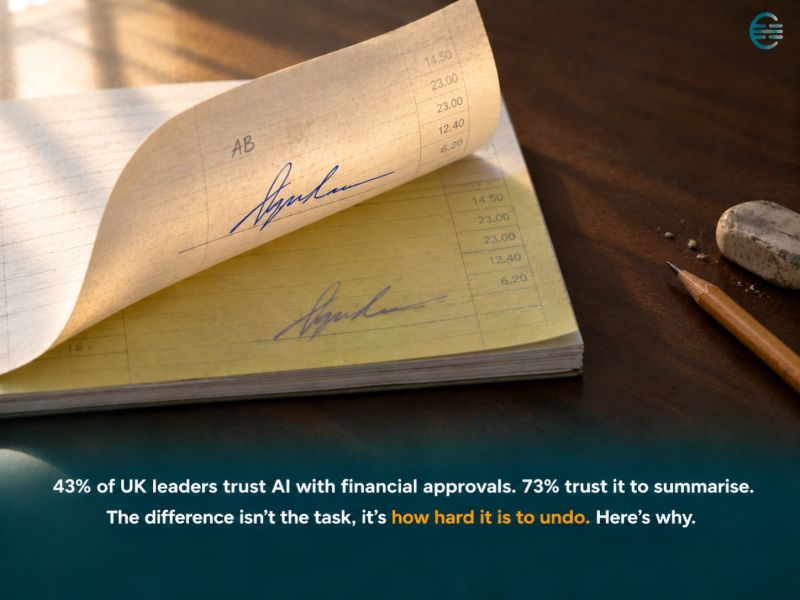
Fewer than half do. Expleo's AI Pulse research, published in August 2026, found that only 43% of UK business leaders trust AI to approve financial or budget-related transactions. For summarising emails, documents or meeting notes, the figure is 73%. For decisions made inside predefined rules or guardrails, it is 54%.
- 73% trust AI to summarise emails, documents or meeting notes
- 54% trust AI to make decisions within preset rules
- 43% trust AI to make financial or budget approvals
Expleo calls this an "AI autonomy cliff". Same leaders, same tools, same month. The only thing that changes between the three numbers is what the AI is being asked to do.
This Is Not a Rejection of AI
It would be easy to read 43% as scepticism. The rest of the research doesn't support that. In the same survey, overall sentiment towards AI improved, with Expleo's sentiment score rising from 63 to 65, and confidence in organisations' ability to use AI successfully rising from 62% to 67%.
So leaders became more positive about AI and still drew a firm line at financial approvals. The drop seems to follow the size of the consequence rather than any view of the technology itself. A poor summary is fixed in seconds. A wrong financial approval is much harder to undo.
Trust in AI doesn't fall because the task gets more complicated. It falls because the mistake gets more expensive to reverse.
The Undo Test: A Simple Way to Sort the Work
That pattern is useful, because it turns a vague question ("where should we use AI?") into a practical one. We call this simple sorting method the Undo Test. For any task, ask what happens if it goes wrong, and how hard it is to put right.
Easy to spot and fix in minutes? Let the tool run.
A draft summary of a client email thread, a first-pass transaction categorisation, a suggested narrative for a set of notes. If it's wrong, someone notices and corrects it before it matters.
Costly if it goes wrong? A named person checks it.
Figures heading into a VAT return, a payroll run before it's processed, a set of management accounts a client will make decisions from. The tool can prepare. A specific person, not "the team", checks it.
Hard to undo? A named person signs it.
Anything that gets filed, paid or sent out under the firm's name. A submission can be amended later, but not quietly and not for free. This is where a signature belongs.
The examples above are illustrations, and every practice will sort its own list a little differently. The point of the test is that it gives you a consistent reason for where the line sits, instead of a general feeling of unease about AI. We've covered which tasks AI handles well in accounting and which it doesn't in more detail elsewhere.
The Review Step May Not Be the Slow Part
Go back to the original idea, that review is the bottleneck AI will remove first. The Expleo numbers suggest the opposite. The further a task moves towards a real financial consequence, the less willing people are to let a tool act alone.
So the review step may not be a slow checkpoint. It may be the part people still want a person behind. Clients aren't paying a firm for the speed of its data entry. They're paying for the fact that somebody qualified looked at the numbers and put their name to them.
We saw a similar pattern in how UK boards respond to AI-assisted hiring: where the decision is consequential, a human check gets added back in. And where review is thin, the cost shows up later. A second review layer is one of the more reliable protections a practice has against the errors that turn into claims.
The Same Test Applies to Outside Help
The Undo Test isn't only about software. It applies just as well to outsourcing. When firms worry about handing work to an outside team, the worry is rarely about who prepares a file. The real question is who checks the work and who signs it. That is the heart of the loss-of-control fear around outsourcing.
That is how we run outsourced accounting support for UK accounting firms:
- Prepared by qualified people. Our offshore accounting team of qualified Chartered Accountants prepares the work.
- Checked by a named senior. A senior reviews every file before it comes back to you.
- Signed by you. Your firm keeps the final sign-off.
Preparation moves. The check and the signature stay exactly where the Undo Test says they should.
Try It on Your Own Practice
A useful exercise for a partner meeting: list the ten tasks that take the most hours in your practice each month, and run each one through the three questions. Which pass the Undo Test and can be left to a tool or handed off for preparation? Which need a named check? Which still need a named signature?
Most firms find the list of things that truly need a partner's signature is shorter than the list of things a partner currently touches. That gap is where the capacity is.
Which tasks in your practice pass the Undo Test, and which still need a named signature?
EarthOne's qualified Chartered Accountants prepare the work, a senior reviews every file, and your firm keeps the final sign-off.
Book a free 30-minute consultation